
Yes, pipe damage from the February 2021 Texas freeze can still cause leaks years later. A pipe or fitting that froze without bursting can come out of the storm stretched, cracked, or loosened, and that kind of damage often waits for a pressure spike, a hot summer, or the next cold snap to finally open up. In Hill Country homes, where a lot of plumbing runs through attics, crawlspaces, and long outdoor lines, those slow leaks are still worth hunting for.
This is not about scaring anyone into a repipe. Most homes came through fine once the obvious bursts were fixed. But if your house sat without heat during that storm, or if you have had a leak you could not explain since, here is where 2021 freeze pipe damage tends to hide and how to check for it.
What the February 2021 freeze did to Texas pipes
The February 2021 winter storm put Central Texas plumbing through days of hard freeze that most local homes were never built to handle. NOAA’s National Centers for Environmental Information calls it the Great Texas Freeze of February 11 to 20, 2021, and reports that central Texas, including Austin, saw six to nine consecutive days of freezing temperatures. NCEI also notes the freeze caused water pipes to burst across the state of Texas and was the first billion-dollar weather disaster of 2021.
The Hill Country got some of it first. The National Weather Service office for Austin and San Antonio reports that up to 0.75 inches of freezing rain built up in Llano and Burnet Counties on February 11, and that temperatures across South-Central Texas fell into the single digits and teens as snow moved in on February 15. The office called it an unprecedented eight-day period of winter weather. Widespread power outages meant many houses lost their heat right when they needed it most. Pipes that normally ride out a one-night freeze sat in that cold for days.
Why a pipe that did not burst can still fail later
A pipe does not have to split open during a freeze to be damaged by it. Water expands as it turns to ice, and when an ice plug forms, it traps water between the plug and a closed faucet or valve. Pressure in that trapped section climbs until something gives. Sometimes that is a dramatic burst pipe and instant water damage. Often it is something smaller that nobody notices at the time.
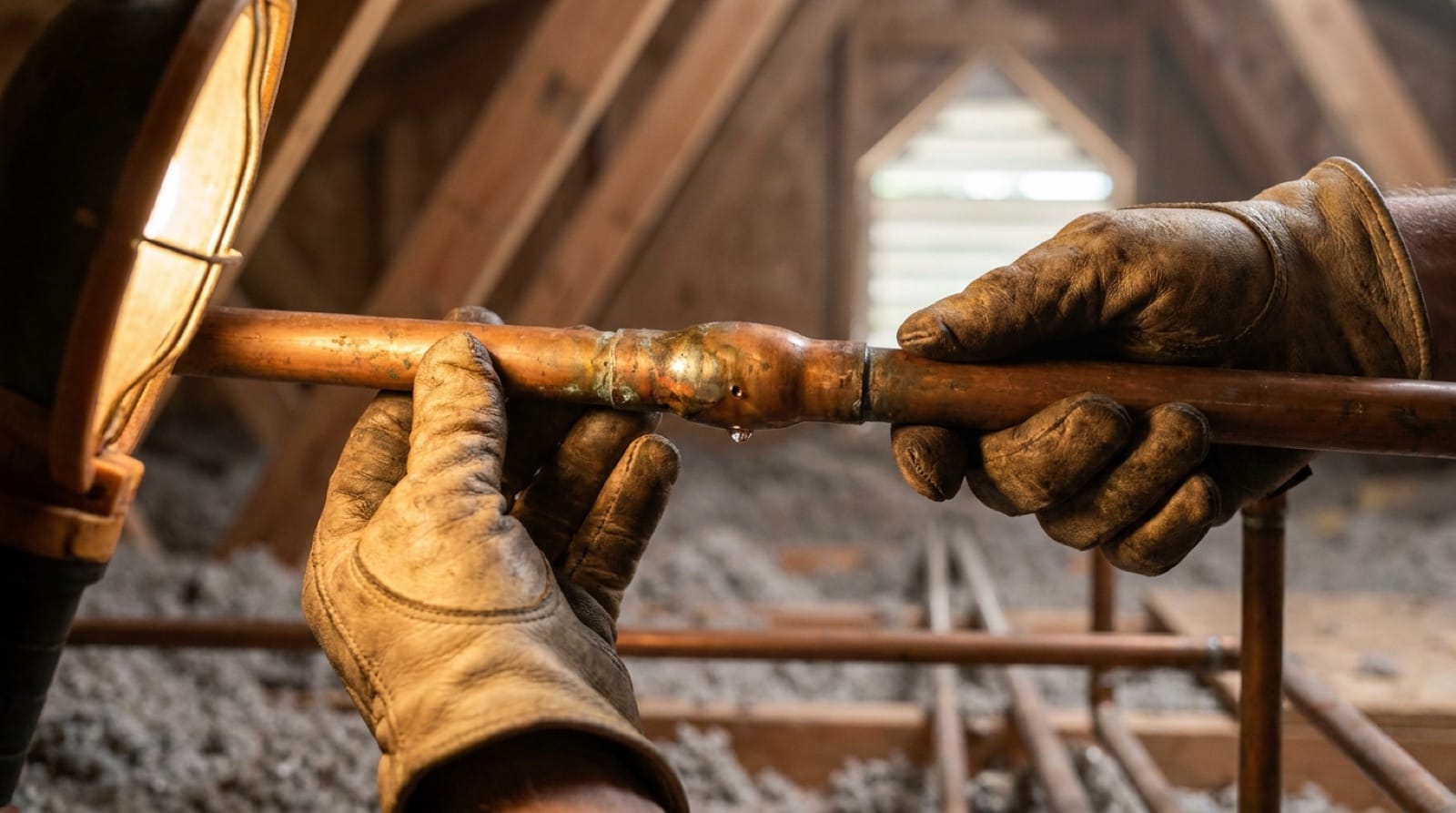
Copper can bulge and thin at the spot that froze in that hard freeze, leaving a weak section that holds for a while and then develops a pinhole. Brass valve bodies and fittings can crack along a seam. Compression nuts and threaded joints can loosen just enough to weep. Rigid plastic pipe like CPVC gets more brittle in the cold and can carry a hairline crack that grows with every pressure swing. The leak you find today may have started as a stress mark in 2021. That is why we treat an unexplained leak in an older, freeze-exposed house as a clue, not a one-off.
Why Hill Country homes took a harder hit
Hill Country homes faced more freeze exposure than a typical tract house in town, mostly because of how and where they are built. Many sit on rock where plumbing could not go deep, so lines run through attics, crawlspaces, or shallow trenches instead. Long runs to barns, guest houses, and stock tanks sit close to the surface. Homes near Lake LBJ, Lake Travis, and the lakes around Marble Falls are often second homes, and a house that sat empty and unheated during the storm may have frozen with nobody there to notice.
Private wells add another layer. Pressure tank piping and the lines in an unheated well house were exposed for days. We do not service well pumps, but the supply line from the tank to the house is plumbing, and it is one of the places we look first. The longer and more exposed the run, the more places it had to be weakened.
Where to check for hidden freeze damage
Freeze damage hides in the same places that froze, so the check starts with any pipe that sits outside the heated part of the house. Here is where we look first on a Hill Country home:
- Attic supply lines, especially near eaves and gable vents, where a slow drip shows up as a ceiling stain long after it starts.
- Sinks, washers, and showers on exterior walls, including the shutoff valves and supply connectors under the sink.
- Water heater connections and the drain valve, especially on a heater in a garage or outdoor closet.
- The irrigation system and its backflow assembly, which sit above ground and crack easily.
- Outdoor runs to shops, barns, and guest houses, and the point where the main line rises out of the ground at the house.
The irrigation system deserves its own mention. The EPA’s WaterSense program advises checking an in-ground irrigation system each spring for damage from frost or freezing, and estimates that a leak about 1/32 of an inch across can waste around 6,300 gallons a month. On a big rural lot, a leak like that can run for months before anyone sees a wet spot.
The repairs made in a hurry
Some of the weakest spots in a post-freeze house are the repairs themselves. After the storm, demand for plumbers was so high that on February 20, 2021, the Governor’s office announced it had temporarily waived certain supervision rules for qualified plumber’s apprentices so more repairs could get done. Homeowners also fixed plenty of pipes themselves, often with whatever couplings the hardware store had left.
That was the right call at the time. Getting water back on mattered more than perfect work. But a quick fix from a week with no supply options was meant to get you through, not to last forever. Push-fit couplings in a hot attic, a patch on a pipe that was already bulged next to it, or a valve that was swapped without checking the line around it are all worth a second look now.
How to check your home for slow leaks today
The fastest way to know whether you have a hidden leak is a meter test. Turn off every fixture, the ice maker, and the irrigation, then watch the small leak indicator on your water meter. If it moves with the house shut off, water is escaping somewhere. We walk through that test step by step in how to read a meter that keeps spinning, and it works on city water. On a private well, a pressure tank that cycles the pump with nothing running points the same way.
Beyond the meter, look for small signs that add up. A water bill that crept up without a reason, a faint ceiling stain, warped baseboard on an exterior wall, a musty cabinet, or the sound of water moving when the house is quiet are all worth noting. One clue is a maybe. Two or three together are a reason to have the system tested. A plumber can pressure-test the lines, isolate sections, and narrow down where the water is going before anyone opens a wall.
Repair the spot or replace the run
Whether you repair one leak or replace a whole run depends on what the rest of the line looks like. A single failure in otherwise sound pipe usually calls for a spot repair. When a freeze-exposed run has leaked more than once, or when the pipe around the leak shows bulging, corrosion, or old patches, the next weak spot is usually close by. That is when replacing the run is the honest answer, not the bigger sale.
For buried and exterior lines, our waterline repair, reroute, and replacement work starts with locating the leak and checking the condition of the pipe around it. Sometimes rerouting a line out of a cold attic or a shallow trench is smarter than putting new pipe back in the same exposed spot. Flexible PEX handles freezing better than rigid pipe, and we often recommend it for these runs. Fixing the leak is half the job. Fixing why that pipe was exposed is the other half.
Have a master plumber check your freeze-exposed lines
If your house went through the 2021 freeze without heat, sits empty part of the year, or has had a leak you could not explain, it is worth having the plumbing checked before the next Texas winter freeze warning. If you are filing a claim, the Texas Department of Insurance says sudden and accidental water damage coverage is what pays for burst pipes, so ask your agent whether you have it and how your policy treats a slow leak. Savior Service Plumbing Company is a family-owned team out of Bastrop led by Texas master plumbers JD Salinas and Stephen Warren, and we work across the Hill Country, from Burnet and Marble Falls to Wimberley and Dripping Springs. We will test the system, show you what we find, and give you a free written estimate after an on-site assessment. Start with our waterline services or request a visit through our quote request form.
Freeze damage questions
Straight answers to the questions homeowners ask us about pipe damage from the 2021 Texas freeze.
Can pipe damage from the 2021 freeze show up years later?
Yes. A pipe or fitting that froze without bursting can be left bulged, cracked, or loosened. Copper can thin into a future pinhole, brass fittings can crack along a seam, and rigid plastic can carry a hairline crack. Those weak spots can hold for years and then open under a pressure spike, summer heat, or the next cold snap.
When was the 2021 Texas freeze?
NOAA's National Centers for Environmental Information dates the Great Texas Freeze to February 11 to 20, 2021, with six to nine consecutive days of freezing temperatures in central Texas, including Austin. The National Weather Service office for Austin and San Antonio reports temperatures fell into the single digits and teens across South-Central Texas as snow moved in on February 15.
Does homeowners insurance cover frozen pipes?
It depends on the policy and on what you did to protect the pipes. The Texas Department of Insurance says sudden and accidental water damage coverage is what pays for burst pipes, and that policies might not pay for frozen pipe damage if you did not take steps to protect your pipes. Ask your agent how your policy treats slow leaks.
How do I check my house for a hidden leak?
Start with a meter test. Turn off every fixture, the ice maker, and irrigation, then watch the leak indicator on the water meter. If it moves, water is escaping. Then look for a rising bill, ceiling stains, warped baseboards, or musty cabinets. Two or three signs together are a reason to have a plumber pressure-test the lines.
Should I replace pipes that froze in 2021?
Not automatically. A single leak in otherwise sound pipe usually calls for a spot repair. If a freeze-exposed run has leaked more than once, or the pipe around a leak shows bulging, corrosion, or old patches, replacing or rerouting that run out of the cold is usually the better long-term answer. An on-site assessment should decide it.