
If your Austin-area home went up in the 1960s or early 1970s and still has its original cast iron sewer pipes, that plumbing is at or past the end of its expected service life. That is not a scare tactic, it is arithmetic. Buried cast iron waste pipe lasts about 50 to 60 years, and a house built in 1968 is now well past that mark. So when a mid-century home starts backing up in the same spot again and again, the real question is no longer how to clear it. It is whether cast iron sewer line replacement finally beats another round of patching.
This is a master plumber’s repair-or-replace decision for old cast iron: how long the pipe really lasts, the signs it is failing for good, what a camera inspection settles, and how spot repair, lining, and full replacement actually compare.
How long cast iron sewer pipe lasts and why mid-century homes are due
Cast iron sewer pipe has a service life of about 50 to 60 years below ground, according to the InterNACHI life expectancy chart. Cast iron was the standard material for drain and sewer lines for decades, and plastic drain pipe only spread through the building trades over the course of the 1970s. That means a 1960s home very likely started with cast iron, while a 1970s home could have either, which is one more reason to look before assuming.
Do the math on a house from 1965 and its original cast iron sewer is now around 60 years old, right at the end of the range. Austin grew fast in those decades, so a lot of the city’s older neighborhoods are full of houses in exactly this window. If you own one and have never had the sewer line looked at, you are relying on a pipe that has already given most of its useful life.
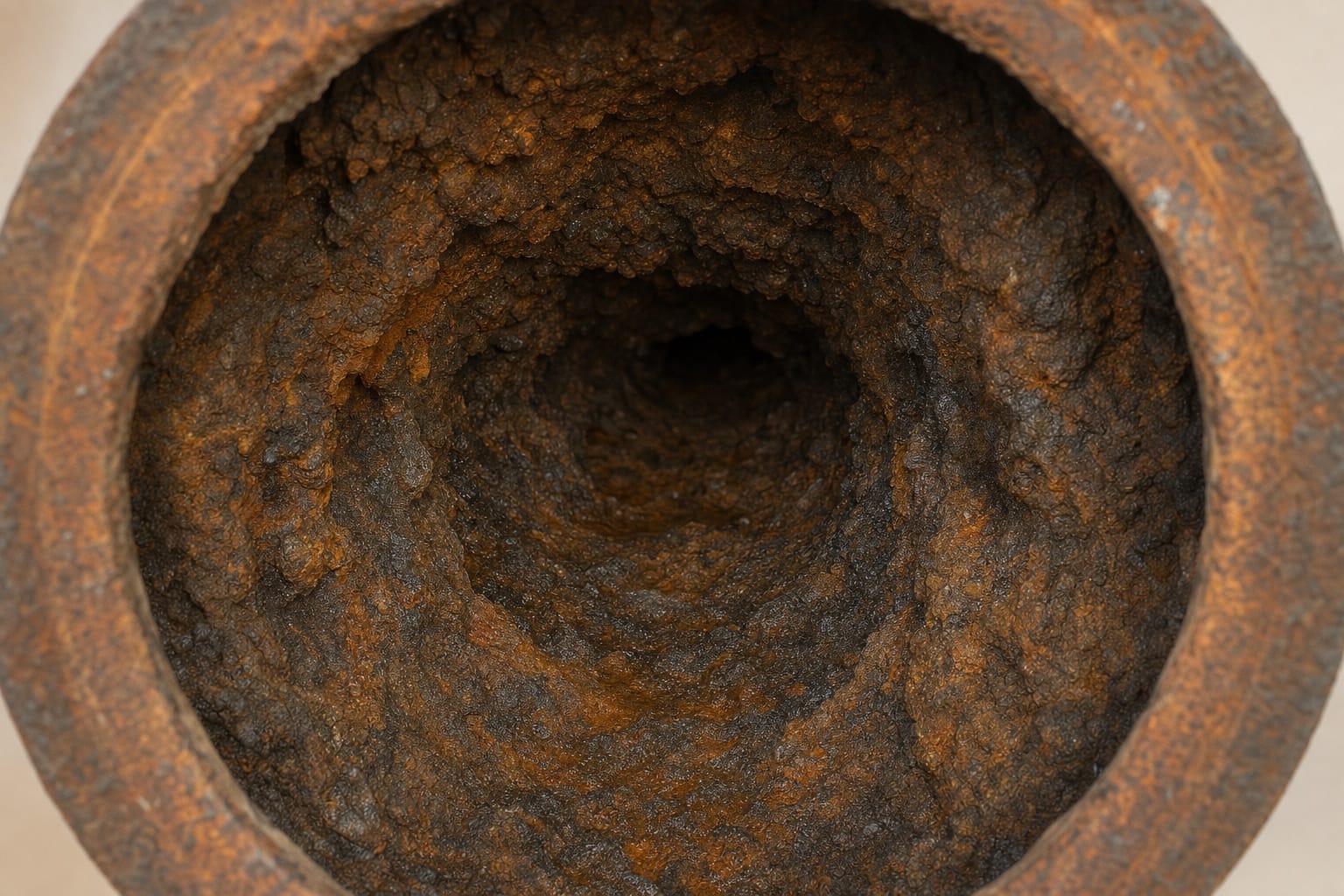
Signs your cast iron sewer line needs replacement
The clearest sign that a cast iron sewer line needs replacement rather than another patch is trouble that keeps returning to the same line, even after pipe repairs. Cast iron fails from the inside out: corrosion builds rough tubercles of rust that narrow the pipe, trap waste, and eventually crack or channel along the bottom where water runs. By the time you see symptoms, old cast iron is usually failing in more than one place.
Watch for these signs:
- Recurring backups in the same line that return weeks after a cabling.
- Multiple slow drains across the house, pointing to the main rather than one fixture.
- Sewage odor indoors or a soggy spot in the yard over the line.
- Seepage at the slab or recurring moisture around the foundation.
- Heavy scale and channeling on camera, the rust buildup that shows the pipe is near the end.
One patch on an old line can be reasonable. A second patch on the same cast iron sewer is usually money spent slowing down a pipe that is failing everywhere at once. If your home also has old galvanized drains that keep clogging inside the walls, the same aging logic applies to those branch lines.
How a camera inspection decides repair versus replace
A camera inspection is what turns repair versus replace from a guess into a decision. We run a camera the length of the line and grade the pipe: is the damage one isolated spot in otherwise sound pipe, or is the whole run corroded, cracked, and channeled? That single distinction drives everything that follows.
The camera also finds the problems that change the plan. A belly, where a section has sagged and holds water, will not drain right even after cleaning. A collapse rules out lining. An under-slab run changes how a replacement gets done, and where a slab sits on shrink-swell clay, decades of movement can add offsets and cracks to pipe that was already thinning. Reading all of that before quoting a fix is the difference between an honest recommendation and selling the biggest job on the menu.
Spot repair, trenchless lining, or full replacement
Once the camera shows the real condition, there are three honest paths. The right one depends on how much of the cast iron is still sound.
- Spot repair. When damage is isolated in an otherwise sound line, a single section gets cut out and replaced. It is the least invasive option, but only appropriate when the rest of the pipe has real life left.
- Trenchless pipe lining (CIPP). A resin-saturated liner is cured inside the existing pipe to form a new pipe within the old one. The National Association of Sewer Service Companies says a properly designed, installed, and tested CIPP lateral liner has a minimum life expectancy of 50 years. Lining is specialty trenchless work and needs a host pipe that is structurally sound enough to line.
- Full replacement. When the line is collapsed, bellied, or corroded end to end, the failed cast iron comes out and modern pipe goes in.
Our own work is traditional spot repair and replacement, and we make the call from the camera, not from a price sheet. If the footage shows a line that is a good lining candidate, we will tell you that too. For a straight read on which your line needs, our sewer line repair and replacement work always starts with the inspection.
| Option | Best when | What you get |
|---|---|---|
| Spot repair | Isolated damage in sound pipe | One section fixed, least invasive |
| Trenchless lining (CIPP) | Host pipe still structurally sound | New liner inside the old pipe, 50 year minimum life expectancy (NASSCO) |
| Full replacement | Collapsed, bellied, or corroded end to end | Modern PVC or ABS, excavation required |
When trenchless lining is not the answer
Lining is a good option right up until it is the wrong one. A liner forms a new pipe inside the old one, so it needs an old pipe that can still serve as a host. Lining cannot fix a pipe that has already collapsed, it cannot correct a significant belly, and it is not the move for cast iron that has channeled or corroded straight through along the bottom. A liner also slightly reduces the inside diameter, which matters on smaller lines.
This is where a neutral plumber and a lining-only contractor can give different answers. A company that only sells liners will look for a way to line. We look at the camera and tell you when the pipe is too far gone for a liner to help, because lining a failed pipe just buys a short delay before the real repair.
Why replacement means excavation and what restoration involves
Full cast iron replacement requires excavation, and that is the part homeowners feel most. Reaching a buried or under-slab sewer line means digging, either an open trench across the yard or a cut through the slab to reach pipe running under the house. There is no way around the fact that replacing a pipe you cannot see requires getting to it.
That is why restoration belongs in an honest replacement quote. Open-trench work disturbs lawns, beds, drives, and walkways; under-slab work means breaking and repouring concrete inside the house. A replacement that ignores restoration is not a complete quote. We walk through what the excavation will touch and what putting it back involves before any digging starts, so the scope is clear up front.
What drives the cost of cast iron sewer line replacement
There is no honest flat price for cast iron sewer line replacement, because the cost of cast iron pipe replacement is driven by the specifics of your line. Anyone quoting a number sight unseen is guessing. The factors that actually move the price are:
- Length and depth of the line that needs work.
- Yard versus under-slab. A line under the foundation costs more to reach than one in the yard.
- Access. Tight lots, mature trees, and hardscape all add labor.
- Restoration of concrete, landscaping, and hardscape after the dig.
- Permits and inspections required by the local jurisdiction.
- Method: spot repair, lining, or full replacement.
People search for a cost per foot, and that framing is fine for understanding that a longer or deeper line costs more. But the only number worth trusting is a free written estimate after an on-site assessment, because the camera and the layout decide the real figure.
Permits, timeline, and the modern pipe you get
Sewer line replacement is permitted work, and the rules vary by jurisdiction, so the permit and inspection steps depend on your city or county rather than a single statewide rule. How long the job takes depends on length, depth, and whether the slab has to be opened, and the timeline belongs in the written estimate along with the permit and inspection steps.
The upside of replacement is what you end up with. Old cast iron gets swapped for modern PVC or ABS, which the InterNACHI chart rates at 50 to 80 years, and N.C. State Extension notes that modern PVC sewer pipe should not break down or rot out for 100 years or longer. You trade a pipe at the end of its life for one that will likely outlast your time in the house, with smooth walls that do not tuberculate the way cast iron does. If the supply side of your house is just as old, our guide to a PEX vs copper repipe in Central Texas covers that separate decision.
Find out where your cast iron really stands
Old cast iron does not fail on a schedule you can see from the kitchen, which is why guessing is expensive. A camera inspection grades the pipe, and from there the choice between spot repair, lining, and full replacement is a clear one based on what the line actually shows. If your mid-century home in Austin or the surrounding area keeps backing up, our licensed plumbers can inspect the line through our sewer and drain services and give you a straight answer, with a free written estimate, before any digging is on the table.
Cast iron sewer line questions
Straight answers to the questions homeowners ask us about cast iron sewer line replacement.
How much does it cost to replace a cast iron sewer line?
There is no honest flat price, because cost depends on the length and depth of the line, whether it runs under the slab, access, restoration, permits, and the repair method. A cost per foot only tells you longer lines cost more. The number worth trusting is a free written estimate after an on-site assessment, because the camera and the layout decide the real scope.
How long do cast iron sewer pipes last?
Cast iron waste pipe lasts about 50 to 60 years below ground, according to the InterNACHI life expectancy chart. Homes built in the 1960s and early 1970s that still have their original cast iron are now at or past that range, which is why so many mid-century Austin-area houses are seeing recurring backups, scale, and cracked or channeled pipe.
Can you repair a cast iron pipe instead of replacing it?
Sometimes. If a camera shows isolated damage in an otherwise sound line, a spot repair, or lining where the pipe qualifies, can be the right call. If the pipe is collapsed, bellied, or corroded from end to end, patching only delays the inevitable and full replacement is the honest recommendation. The camera footage decides, not a price sheet.
Why does replacing cast iron under a slab cost more?
Under-slab replacement generally costs more than a yard line because reaching the pipe means cutting and repouring concrete inside the house and working in tighter space. The drivers are access and restoration, not a fixed rate. A camera inspection and an on-site assessment are the only way to scope it accurately before you get a written estimate.
Is trenchless lining as good as replacement?
When the host pipe qualifies, a properly installed CIPP liner has a minimum life expectancy of 50 years according to NASSCO and avoids most digging. But lining cannot fix a collapsed or badly bellied pipe, and it slightly reduces the inside diameter. For cast iron that is too far gone, replacement with modern PVC or ABS is the better long-term value.