
A tank water heater in Central Texas usually lasts about 8 to 12 years, and hard water is the main reason so many land at the short end of that range. Minerals settle in the bottom of the tank every time it heats, and that layer makes the heater work harder and wears it out sooner. The tank does not quit on a calendar. It quits because of what the water leaves behind and what the pressure in your lines does to the steel.
Here is what ages a tank on our water, how to date yours, the signs it is near the end, and how a master plumber decides between one more repair and a replacement.
How long does a water heater last in Central Texas
Plan on roughly 8 to 12 years for a standard gas or electric tank water heater. That is the range Rheem gives for traditional tank heaters, and it lines up with what we find when we pull old units around Bastrop and Austin. A. O. Smith goes further and notes that a gas tank may start to fail as soon as six years after installation if it never gets maintenance.
Where your heater lands in that range depends on four things: how hard the water is, how high the water pressure runs, how much hot water the household uses, and whether anyone ever flushed the tank. InterNACHI’s water heater lifespan guide puts typical water heater life at about 10 years and says plainly that in areas with higher mineral content, water heaters have shorter lifespans. That describes a lot of Central Texas. A tankless water heater is a different machine with a longer expected life, and choosing one is a separate decision with its own trade-offs on our water. Age alone does not kill a tank, but age on hard water usually does.
What hard water does inside the tank
Hard water leaves calcium and magnesium on the floor of the tank as sediment, and that sediment is what shortens the life of a tank water heater. The USGS classifies water at 121 to 180 milligrams per liter of hardness as hard and anything above 180 as very hard. Plenty of Central Texas water, especially from private wells, lands in those top two classes.
Every heating cycle drops a little more mineral out of the water. On a gas heater, the burner sits under the tank, so the flame has to push heat through that crust to reach the water. Sediment is insulation sitting between the heat and the water, so the steel at the bottom runs hotter and the burner runs longer. The rumbling or popping you hear is water trapped under the sediment flashing to steam. On an electric heater, the lower element gets buried in the buildup and tends to burn out early. Either way, you pay more to heat the same water while the tank takes extra stress it was never built for.
What else shortens tank life here
Water pressure is the second big factor, and it is easy to miss because high pressure feels good at the shower. Rheem recommends keeping household pressure around 40 to 60 psi because higher pressure puts added stress on the tank and its connections. On top of that, water expands as it heats, and in a closed system that expansion pushes the pressure up again every cycle. Many newer Central Texas neighborhoods see high street pressure, which is why a worn pressure regulator in a newer subdivision can quietly take years off a water heater.
Usage matters too. InterNACHI notes that the more water a heater moves, the harder it works and the more corrosive wear it takes, so a family of six burns through a tank faster than a couple does. A heater sitting on a damp garage slab also rusts from the outside in. Finally, the sacrificial anode rod inside the tank gets used up over time, and once it is gone the steel itself starts to corrode.
How to tell how old your water heater is
Look at the rating label on the side of the tank and find the serial number, because most manufacturers encode the build date in it. Rheem points to the serial number as the place to start. The format varies by brand. Some use a letter for the month and two digits for the year, and others lead with the year and the week. If you cannot decode it, the manufacturer’s website or support line can.
Some installers also write the install date on the tank or leave a sticker nearby, so check the top and the front of the heater. Write the year down somewhere you will find it later. The age on the label matters more than how the heater looks from the outside, because a clean jacket can hide a tank that has been corroding from the inside for years. If the label says 10 years or more, start planning for how long it will realistically last, even if the heater is still working fine today.
Signs a tank is near the end
The clearest sign is water coming from the tank itself, and that one has no repair. Before you assume the worst, though, figure out exactly where the water is coming from. These are the warning signs worth acting on:
- Water at the base that is not coming from a fitting, valve, or supply line above it.
- Rusty or discolored hot water while the cold water at the same faucet runs clear.
- Rumbling, popping, or crackling as the heater fires, which means heavy sediment.
- Hot water running out faster than it used to with the same household routine.
- Rust on the fittings at the top of the tank or around the burner access on a gas unit.
A drip from a supply connection or the drain valve is usually a simple repair. A wet base with no leak above it usually means the steel has rusted through. Rheem lists leaks from the base, rusty water, and persistent rumbling as clear replacement signs once a unit has some age on it.
Repair or replace, and how we make the call
Repair makes sense when a replaceable part fails on a younger heater, and replacement makes sense when the tank is leaking or the repairs keep stacking up. Thermostats, heating elements, gas control valves, and relief valves are all made to be swapped. A tank that leaks cannot be patched. That part of the decision is simple.
The gray area is the older heater with a failed part. Rheem suggests repair is reasonable on a unit under about 6 to 8 years old with no corrosion, and that replacement usually wins once a repair runs past half the price of a new heater. InterNACHI offers a similar test: if yearly repair costs pass about 10 percent of the cost of a new installed heater, the parts are probably not worth it. We look at the age, the condition of the tank, and what is actually broken, then give you the honest answer. Sometimes that answer is a part and a flush. That is what tank water heater repair and replacement should look like: diagnose first, recommend second, and never sell a tank to fix a thermostat.
When water heater replacement is the right call, the new heater has to meet current code. Depending on the house, that can mean a thermal expansion tank, a drain pan, a properly routed relief valve discharge line, or venting corrections on a gas unit. It is better to know that before the old heater comes out.
What actually stretches tank life on hard water
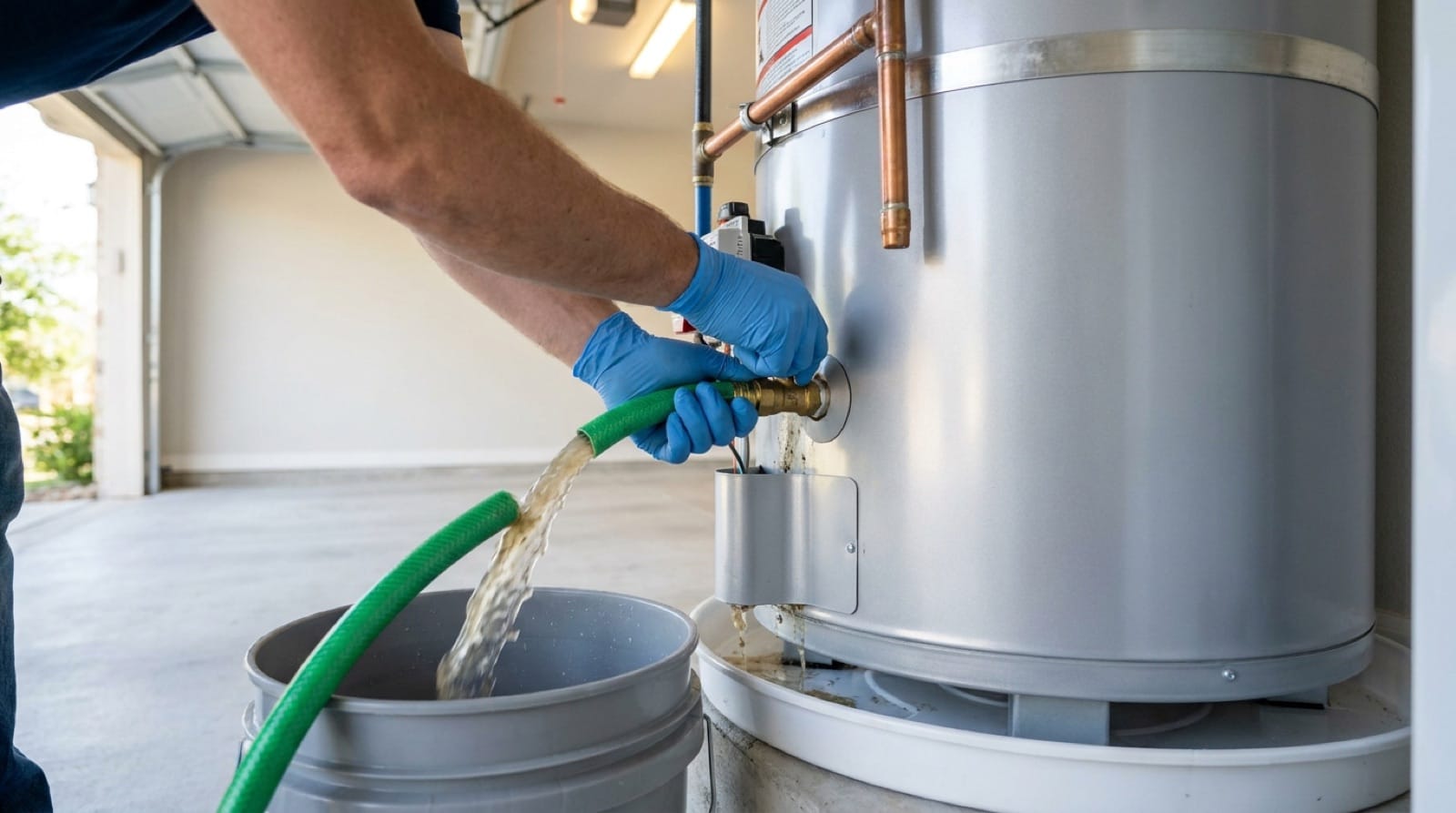
Regular flushing is the single best habit for a tank on Central Texas water. A. O. Smith says most tank heaters need flushing at least once a year and more often in hard water areas, because minerals build up as sediment that cuts efficiency and raises the risk of leaks. Flushing pulls that sediment out before it hardens into a crust. One caution: on a tank that has gone ten years without a flush, opening the drain can stir up heavy sediment or leave you with a drain valve that will not seal again. On a neglected older tank, start with an inspection before a first flush.
Beyond flushing, keep the water pressure in the normal range and add an expansion tank where the system needs one. Set the thermostat around 120°F, which is the setting A. O. Smith recommends and which slows mineral drop compared to a hotter setting. A water softener stops most of the sediment before it forms, though softened water changes how fast the tank uses up its internal corrosion protection. Have the anode rod checked on schedule, since it is the part that keeps the tank from rusting. A tank that gets this attention usually reaches the long end of its range.
Get an honest read on your water heater
If your tank is past the 10 year mark, rumbling every time it fires, or leaving rust in the hot water, it is worth a look before it fails on its own schedule. Savior Service Plumbing Company was founded in 2017 by JD Salinas, a Texas master plumber, and our licensed plumbers service and replace tank heaters across Bastrop, Austin, and the Hill Country. Through our water heater services, we will check the age, the tank, the pressure, and the parts, and tell you straight whether it needs a repair, a flush, or a replacement. You get a free written estimate after the on-site assessment, Monday through Friday, 8 AM to 5 PM. Request your estimate here.
Water heater lifespan questions
Straight answers to the questions homeowners ask us about how long a tank water heater lasts.
How long does a water heater last in Central Texas?
A standard gas or electric tank usually lasts about 8 to 12 years, the range Rheem gives for tank heaters. Hard water, high water pressure, heavy household use and skipped flushing all push a heater toward the short end. A well maintained tank on moderate pressure has the best chance of reaching the long end of that range.
Can a tank water heater last 20 years?
It happens, but it is the exception on Central Texas water. Most tanks fail well before that because sediment and corrosion wear out the steel. If yours is past 15 years and still running, it has done its job. Plan the replacement on your schedule instead of waiting for the tank to leak and decide for you.
What are the first signs a water heater is going bad?
Rumbling or popping when it fires, rusty hot water while the cold runs clear, hot water running out sooner than it used to, and water at the base of the tank. A drip from a fitting or valve is usually repairable. Water coming from the tank body itself means the steel has rusted through and the heater needs replacing.
How do I find out how old my water heater is?
Check the serial number on the rating label on the side of the tank. Most manufacturers encode the build month and year in it, though the format varies by brand. If you cannot decode it, the manufacturer's website or support line can. Some installers also write the install date on the tank or leave a sticker nearby.
Does flushing really make a tank water heater last longer?
Yes. Flushing pulls out the mineral sediment that hard water leaves on the tank floor before it hardens into a crust that overheats the bottom and buries the lower element. A. O. Smith says most tanks need flushing at least once a year and more often on hard water. On a tank that has never been flushed, get it inspected before a first flush.