
Tankless water heater sizing comes down to two numbers: how many gallons per minute of hot water your house uses at its busiest moment, and how many degrees the heater has to raise the incoming water. Gallons of storage stop mattering once the tank is gone. Hard Hill Country water adds a third factor, because mineral scale slowly cuts what the heat exchanger can deliver, so a unit sized with zero margin on day one can come up short a few years later.
Here is the math a plumber actually runs, with real fixture numbers, plus the places where winter water, fuel type, and hardness change the answer for a Central Texas home.
The two numbers that set tankless water heater size
Every tankless water heater is sized on peak flow rate and temperature rise, not on gallons. Navien’s sizing guide lays it out the same way: add up the flow of every fixture that will run at the same time, then figure the difference between the temperature you want and the temperature of the water coming in. Those two numbers together tell you which of the tankless water heaters on the market can keep up with your home.
The reason both matter is that a tankless heater has a fixed heating capacity from its burner or elements. It can spend that power heating a lot of water a little, or a little water a lot. The same heater delivers fewer gallons per minute as the temperature rise gets bigger. Every manufacturer publishes a chart showing flow at different rises, and reading that chart against your own house is the whole sizing job. A unit that looks huge on paper at a small rise can feel undersized on the coldest morning of the year.
Adding up your peak hot water demand
Peak demand is the total flow of every hot water fixture that realistically runs at once, measured in gallons per minute (GPM). A. O. Smith uses round planning numbers for whole house tankless sizing, and the EPA notes that standard showerheads use 2.5 gallons per minute while WaterSense labeled heads use no more than 2.0. Typical planning figures look like this:
- Shower: 2.5 GPM standard, 2.0 GPM for a WaterSense head
- Kitchen or bathroom faucet: about 0.75 GPM
- Dishwasher: about 1.5 GPM
- Washing machine on a hot fill: 3 to 5 GPM by Navien’s estimate
Now picture a weekday morning in a family of four: two showers running and the kitchen faucet on. With standard heads that is 5.75 GPM. With WaterSense heads it drops to 4.75. A shower mixes in some cold water, so the hot side draws less than the full head rating in summer. In a cold snap, though, the mix leans heavily toward hot, which is why we size on full fixture flow, not the summer mix. Rain heads, body sprays, and a big soaking tub change the math fast, so count those separately.
If you are replacing a 40 or 50 gallon tank water heater, the old tank size tells you very little. A tank is sized on stored gallons, a tankless on gallons per minute, so the right water heater size comes from your fixtures, not the label on the old unit. Two people with one shower running at a time need a far smaller unit than a family that runs three bathrooms at once.
Temperature rise and why winter sets the size
Temperature rise is your setpoint minus the temperature of the water coming into the house, and it should be figured for the coldest days of the year. Navien gives a simple example: set the heater at 120°F, bring in water at 55°F, and the heater needs a 65 degree rise. Most homes run 120°F or 125°F at the heater.
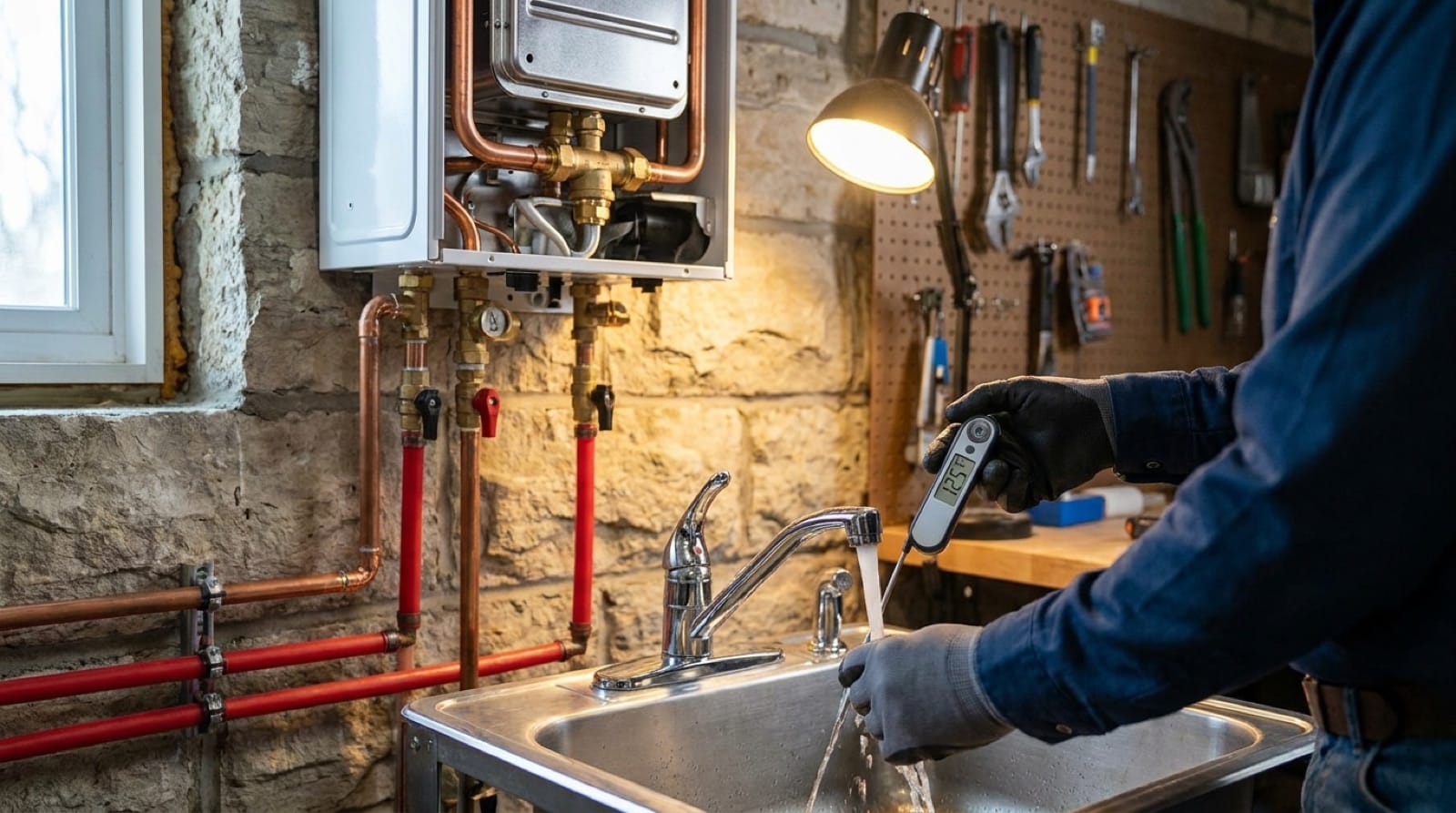
In the Hill Country and around Austin, incoming water swings with the seasons. Water from a private well or a lake-fed city system arrives noticeably warmer in August than during a hard freeze. A heater sized on a summer reading looks fine for nine months and then leaves someone in a lukewarm shower in January. The honest move is to measure the incoming temperature at the house and size for the coldest stretch you can reasonably expect, not the average day. Plugging that winter rise into the manufacturer’s chart against your peak GPM is what separates a good fit from a callback.
Gas or electric changes what is possible
Gas and propane water heaters in the tankless category can deliver far more hot water than electric ones, so fuel type often decides whether one tankless can run the whole house. A. O. Smith puts gas tankless models at about 5 to 10 gallons per minute and electric models at 2 to 5. That is why people who choose an electric water heater in tankless form often use it for a smaller home or a single bathroom. A family with two showers and a dishwasher going at once usually lands in gas territory.
Each fuel brings a second question about supply. A whole house electric tankless draws a lot of current, and the panel and wiring may need upgrades, which is a job for a licensed electrician. A gas or propane tankless often needs a larger gas supply than the tank it replaces. We handle the heater and its venting, but upsizing or extending gas piping is separate work for a licensed gas professional. We will tell you up front if your house needs either, before anything gets ordered. That conversation is a normal part of planning any tankless water heater installation out here, where many homes run on propane and older electrical service.
How hard water changes the sizing math
Hard water does not change your peak demand, but it shrinks the heater’s real output over time, so you size with a margin instead of to the exact number. Scale builds inside the heat exchanger, and that layer slows the transfer of heat into the water, so less of the unit’s water heating capacity reaches your shower. A heater that just barely covered your peak when it was new will start falling short as scale builds, and the first sign is usually a shower that drifts cooler when a second fixture opens.
That does not mean you buy the biggest unit on the shelf to outrun the minerals. Oversizing to fight scale trades one problem for another, which the next section covers. The better plan on Hill Country water is a modest margin above your winter peak, a water test before the install, treatment if the hardness is high, and a descaling schedule the homeowner actually keeps. Sizing and scale control are one decision, not two.
Minimum flow and the problem with oversizing
A tankless heater will not fire until enough water moves through it, and a bigger unit is not automatically a better one. Noritz notes that most tankless units need a minimum flow of about 0.5 GPM to activate. A bathroom faucet cracked partway open, or an extra-low-flow fixture, can sit right around that line and never trigger the burner.
An oversized unit also costs more up front, may need more gas supply than the house has, and gains you nothing if your real peak never touches its capacity. Right-sized beats oversized on both comfort and cost. If you want instant hot water at a far bathroom, decide that during sizing, because a loop changes how the heater runs. We cover the trade-offs of adding a recirculation pump to a tankless system in detail. For very large homes, two smaller units working together can cover a big peak while still firing reliably on a single faucet.
How we size a tankless on a site visit
We size a tankless by walking the house and measuring, not by square footage or a rule of thumb. On an on-site assessment, our plumbers work through the same checklist every time:
- Count every hot water fixture and note its real flow rate, including any rain heads, body sprays, or large tubs.
- Ask how the household actually uses hot water and which fixtures overlap.
- Measure the incoming water temperature and plan for winter.
- Test hardness so scale control is part of the plan from the start.
- Check fuel type, venting path, and whether gas supply or electrical service will need another trade.
Then we match a model to your winter peak with a reasonable margin and show you the chart behind the choice. You should be able to see why a unit fits, not just take our word for it.
Get the sizing right before the install
A tankless that is sized to your fixtures, your winter water, and your hardness will run for years without drama. One sized off a sales sheet usually shows its limits the first cold morning. Savior Service Plumbing Company is led by Texas master plumber JD Salinas, with master plumber Stephen Warren bringing more than 25 years in the trade, and we would rather spend an extra half hour measuring than come back to fix a bad fit. If you are thinking about going tankless anywhere from Bastrop to the Hill Country, our water heater team will size it from your actual house and give you a free written estimate after the on-site assessment, Monday through Friday, 8 AM to 5 PM. Request your estimate here.
Tankless sizing questions
Straight answers to the questions homeowners ask us about sizing a tankless water heater.
How do I figure out what size tankless water heater I need?
Add up the flow, in gallons per minute, of every hot water fixture that runs at the same time, then figure the temperature rise from your incoming water to your setpoint on the coldest days. Compare both numbers to the manufacturer's flow chart. The right unit covers your winter peak with a modest margin, not just your summer use.
How many GPM does a family of four need from a tankless?
It depends on how many fixtures overlap, not the head count. Two showers and a kitchen faucet at once come to about 5.75 GPM with standard 2.5 GPM showerheads, or 4.75 GPM with WaterSense heads. Many families of four land in that range, which usually points to a gas or propane unit rather than electric.
What size tankless replaces a 40 gallon tank?
The old tank size does not translate. A tank is sized on stored gallons and a tankless on gallons per minute, so the answer comes from your fixtures and your winter water temperature. A two person home with one shower at a time needs a far smaller unit than a family running three bathrooms at once.
Does hard water change the size of tankless I need?
It does not change your peak demand, but scale on the heat exchanger cuts real output over time, so size with a modest margin above your winter peak. Do not oversize to outrun the minerals. Test the water, treat it if hardness is high, and keep the unit on a regular descaling schedule instead.
Is a 9.5 GPM tankless water heater enough?
For many homes, yes, but only at the temperature rise the rating assumes. A heater rated at 9.5 GPM delivers less on a cold winter morning when the rise is larger. Check the manufacturer's chart at your winter rise against your real peak demand. If it still covers your overlapping fixtures with some room to spare, it is enough.