
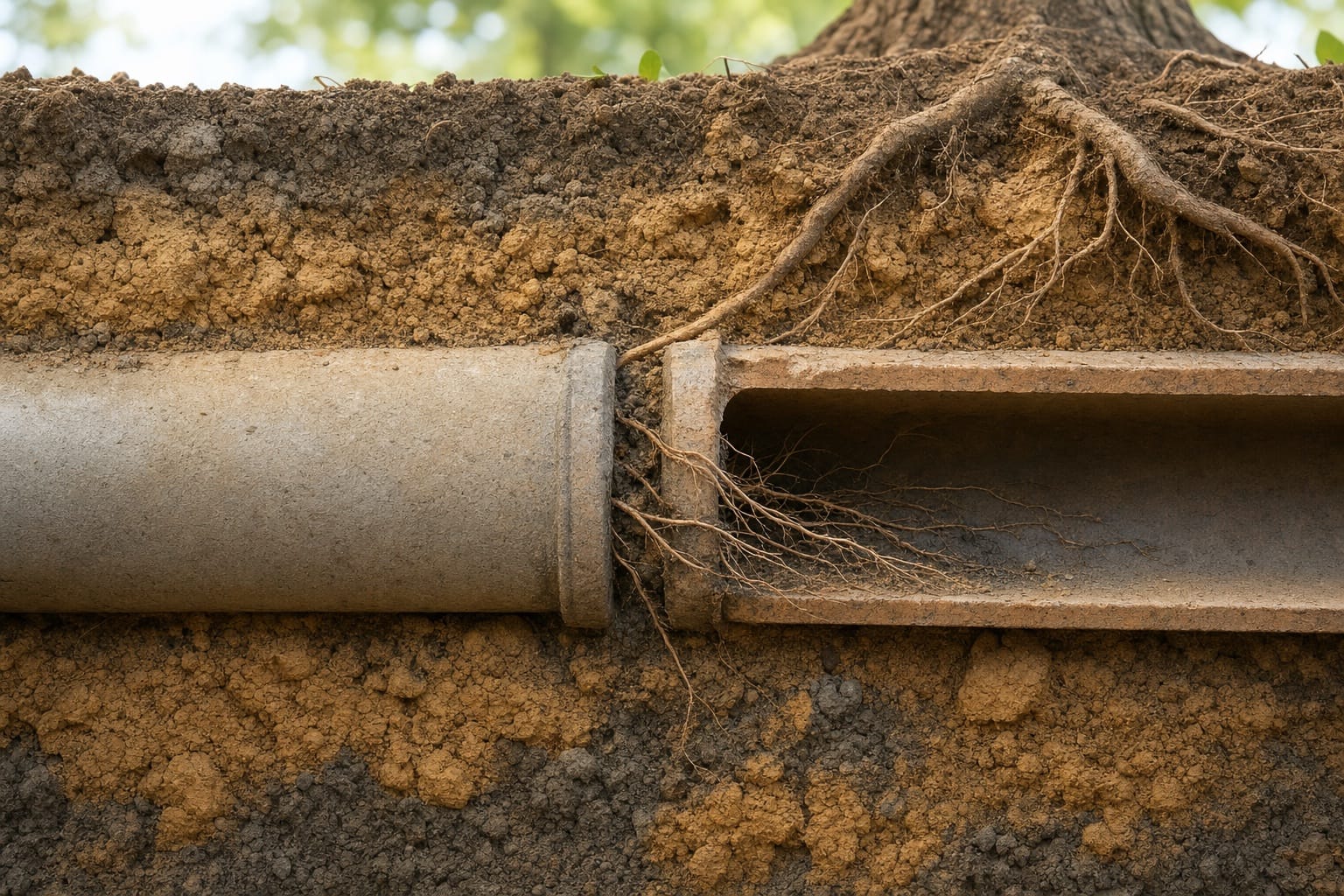
When a sewer line backs up in Central Texas, most people blame the tree in the yard. The tree is rarely the real problem. Roots cannot break into a sound sewer pipe. They find a hairline crack or an offset joint that is already there, follow the moisture, and grow until they choke the line. That is how tree roots in a sewer line turn a small defect into a main-line backup, and older lines under mature trees, from Bastrop to the Hill Country, are where it happens most.
Here is how roots get in, the warning signs to catch early, what a sewer camera shows, and how the right fix gets chosen from that evidence instead of guesswork.
How tree roots get into a sewer line
Roots get into a sewer line through tiny cracks, small holes, and offset joints that are already in the pipe. N.C. State Extension puts it plainly: tree roots cannot create cracks in a sewer pipe, they can only exploit existing cracks or gaps. A tiny root slips into the opening, finds moisture and nutrients, and grows in diameter, widening the crack as it goes. The breach comes first and the root blockage comes second. Roots find the spot in the main sewer line that was already failing and turn it into a dam.
Root intrusion is not a new or rare problem for sewer systems in general. A 2001 research review co-authored by USDA Forest Service scientists notes that roots are reported to cause more than half of all sewer blockages, with old jointed, shallow, and small-diameter pipes most at risk. Residential sewer lines check all three boxes.
Why Central Texas soil and trees make it worse
Ground movement is what opens the door. Much of Central Texas sits on expansive clay that swells when it is wet and shrinks when it dries, and that seasonal push and pull stresses rigid buried pipe and works the joints between sections loose. In Bastrop County the ground changes from heavy clay to loose sand within a single neighborhood, which is part of why Bastrop clay and sand soil cause different line failures on neighboring lots. Once a shifted joint opens even slightly, a root in the surrounding soil has its way in.
Tree size is the other half. N.C. State Extension notes that roots can spread two to three times as wide as the tree is tall as they search for water, which means a sewer line across the yard is still within reach. Central Texas yards are full of live oaks and pecans, both large, long-lived trees with wide root systems, so any older sewer pipe running through a yard with mature trees is a likely target once a joint opens.
Common warning signs roots are in your line
The clearest warning sign of roots in a sewer line is slow or backed-up drainage that affects multiple fixtures at once. A single slow sink is usually a simple clog. When the toilet gurgles while the washing machine drains, or several drains slow down together, the problem is deeper in the main sewer, where roots collect debris into a dam and choke the flow.
Watch for these warning signs:
- Multiple slow drains across the house, not just one fixture.
- Gurgling from the toilet bowl or kitchen sink as air pushes past a partial blockage.
- Recurring backups that return a few weeks or months after a snaking.
- Sewage odor or a sewage backup indoors, which is both a nuisance and a health hazard.
- Lush green patches or soft, sunken spots in the lawn above the line, fed by leaking wastewater.
A sewer smell in just one room is often a dry trap, a failed wax ring, or a vent problem, which we cover in the real causes of sewer smell in one bathroom. A smell that shows up across the house along with slow drains points back to the main line.
How a camera inspection confirms roots and what it shows
A sewer camera inspection is the only way to confirm that roots, and not grease or a collapse, are the problem. We feed a waterproof camera down the line and watch the pipe on a monitor in real time. That inspection answers the questions that decide the repair: where the breach is, how bad it is, and what the pipe is made of.
Inside the line, the camera typically shows a root mass that looks like a fine white or brown beard pushing in at a joint or crack. We note exactly where it sits and how deep, because that tells us whether the problem is one spot or the entire run. We also read the pipe itself. Old buried cast iron, which the InterNACHI life expectancy chart puts at 50 to 60 years, often shows rust scale and channeling alongside the roots, which narrows the pipe and changes the conversation from cleaning to replacement.
This is the step that separates honest work from guesswork. Camera evidence is why a sewer camera inspection and hydro jetting visit ends with a clear recommendation instead of a bill for a fix nobody confirmed you needed. We share the footage, so you see what we see.
Clearing the roots with root cutting and hydro jetting
Once roots are confirmed, the line gets cleared mechanically before any repair. A root cutter on a cable shears the root mass and restores flow quickly. For a more thorough cleaning, a jetter uses high pressure water to scour the root hairs, grease, and scale a cutter leaves behind off the pipe walls. On a root-fed line, jetting after cutting gives the cleanest result.
Here is the part that gets glossed over: clearing the line does not fix it. Root cutting and jetting remove what grew in, but the crack or open joint that let the roots in is still there. That is why a cut-only job often produces another backup down the road. Clearing is the first step, not the cure, and any plumber who tells you a snaking permanently solved a root problem is not being straight with you.
Do chemical root killers work?
Foaming chemical root treatments can slow regrowth, but they do not repair the pipe and they are not a long-term fix. N.C. State Extension suggests that if you try one, you choose a foaming product built on ingredients like salt, baking soda, dichlobenil, or soap. They do nothing about the breach, so the roots come back through the same opening.
One firm rule from our side: never pour caustic drain openers, the lye and acid products sold for kitchen clogs, into a line with roots. They will not clear a root blockage, N.C. State Extension notes they can damage older sewer pipes and create new openings for roots. If a foaming product fits your situation, treat it as a stopgap between real repairs, not the repair itself.
Fixing the pipe with lining or replacement
The permanent fix is to seal or replace the breach the roots used, and the camera decides which. Where the host pipe is still structurally sound, cured-in-place pipe lining (CIPP) installs a resin liner that cures into a new pipe inside the old one and seals the cracks and joints roots came through. The National Association of Sewer Service Companies says a properly designed, installed, and tested CIPP lateral liner has a minimum life expectancy of 50 years. Lining is specialty trenchless work, and if the footage shows your line is a good lining candidate, we will tell you so.
When the line is collapsed, badly bellied, or deteriorated end to end, lining is not an option, and a spot repair or replacement with modern pipe becomes the right call. That is the traditional repair work we do. The decision is not about selling the bigger job. Isolated damage in a sound pipe leans toward a spot repair or lining, while a failing line from end to end leans toward replacement.
| Method | What it does | What it fixes | How long it holds |
|---|---|---|---|
| Root cutting | Shears the root mass to restore flow | The blockage, not the breach | Until the roots regrow |
| Hydro jetting | High pressure water scours the pipe walls | Roots, grease, and scale, not the breach | Longer than cutting alone, until regrowth |
| CIPP lining | Cures a new liner inside a sound pipe | The cracks and joints roots used | 50 year minimum life expectancy (NASSCO) |
| Replacement | Replaces failed sections with modern pipe | The pipe itself | 50 to 80 years for PVC or ABS (InterNACHI) |
Preventing future root intrusion
The best prevention is a sealed pipe, but a few habits lower the odds of a repeat. On a line that has had roots before, a periodic camera check catches new growth while it is small, and how often depends on the pipe and the trees around it. The Insurance Information Institute notes that homeowners with continuing root problems may need to have roots cut regularly by a professional, and that replacing the line with plastic pipe keeps roots out.
Be realistic about planting, too. N.C. State Extension points out that moving a tree a few feet rarely changes whether its roots reach a line. The reason to keep large trees off the top of the sewer line is so the tree does not have to come down when the line needs work.
Get the line looked at before the next backup
Roots in a sewer line are a solvable problem once you stop guessing and look inside the pipe. Confirm it with a camera, clear the line, then seal or replace the breach based on what the footage shows. If your drains are slowing down together or a backup keeps returning anywhere from Bastrop to Austin, our licensed plumbers can inspect the line through our sewer and drain services and show you exactly what is happening underground, with a free written estimate before any work starts.
Sewer root questions
Straight answers to the questions homeowners ask us about tree roots in sewer lines.
What are the first signs of roots in a sewer line?
The earliest signs are several slow drains at once, gurgling from a toilet or kitchen sink, and backups that keep returning after a snaking. A single slow fixture is usually a simple clog. When the whole house slows together, the problem is in the main sewer line, and roots collecting debris at a cracked joint are a common cause.
How do plumbers confirm tree roots in a line?
With a sewer camera inspection. A waterproof camera is fed down the line so the plumber can see roots at a joint or crack, confirm it is root intrusion rather than grease or a collapse, and read the pipe material and condition. That footage, which we share with you, is what determines the right repair.
Do chemical root killers actually work?
Foaming root treatments can slow regrowth for a while, but they do not repair the pipe, so roots return through the same opening. N.C. State Extension suggests foaming products built on salt, baking soda, dichlobenil, or soap if you try one. Never use caustic lye or acid drain openers, which can damage older sewer pipes.
Will roots come back after cutting?
Yes, unless the breach is sealed or replaced. A root cutter and hydro jetting remove the root mass and restore flow, but the crack or open joint that let the roots in is still there. A cut-only job tends to lead to another backup once the roots grow back, until the pipe itself is repaired, lined, or replaced.
Does homeowners insurance cover tree root damage to a sewer line?
Often not on its own. Many homeowners policies do not cover sewer backups unless you add a sewer backup endorsement, which the Insurance Information Institute says most insurers offer for a modest cost. Gradual root damage to the pipe itself is commonly treated as a maintenance issue. Read your policy and ask your agent before you need it.